STRUCTURED CATALYST IMPROVES EFFICIENCY AND HYDROGEN YIELDS IN STEAM METHANE REFORMING

By Scott Jenkins | December 1, 2021
Commissioning has begun on a pilot plant designed to demonstrate the effectiveness of a structured catalyst module for steam-methane reforming (SMR) that solves the main heat-transfer inefficiencies associated with the conventional process. The structured catalyst technology improves the efficiency of SMR and increases the hydrogen produced.
“Heat transfer in SMR reactors depends in large measure on feed gas impinging the boundary layer of fluid at the tube wall,” explains Bruce Boisture, president and co-founder of ZoneFlow Reactor Technologies, LLC (Windsor, Conn.; www.zoneflowtech.com), the developer of the new SMR technology.
“But that heat-transfer mechanism is not optimized in the reactor tubes because of the random packing of the pellets in the reactor and their relatively large size (a concession to durability concerns) in relation to the diameter of the reactor tube. The result is a random gas-flow pattern within the reactor, sub-optimal heat transfer into the reactor and pressure drop across the reactor, and a significant amount of methane that can ‘bypass’ the catalyst along the tube walls. This high-temperature, but unreacted methane can cause coke buildup on the pellets.”
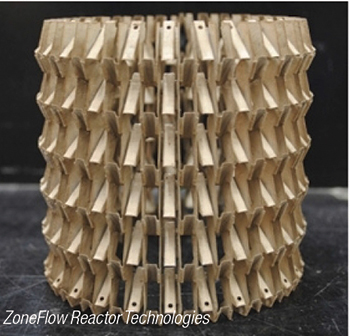
The ZoneFlow structured catalyst (photo) features precisely engineered flow channels in its outer casing that are designed to force the methane to contact the tube wall while minimizing pressure drop. The geometry of its support structure keeps the catalyst-coated casing in continuous contact with the tube wall despite tube creep, eliminating bypass, Boisture comments. “In testing, heat-transfer efficiency was improved by 100% while maintaining the same pressure drop,” Boisture says, which translates into an expected 15% higher throughput compared to conventional catalyst systems.
ZoneFlow’s pilot plant, located at the Université Catholique de Louvain (Belgium), is undergoing final commissioning now, and the plant will start up by the end of 2021. Pilot testing results are expected in mid-2022. In early November, ZoneFlow announced a joint development agreement with Honeywell UOP (Des Plaines, Ill.; www.uop.com) to develop and commercialize the technology. Honeywell says the ZoneFlow reactor technology allows capital savings for new SMR plants and higher productivity for existing plants, and the opportunity to reduce steam requirements for SMR will reduce energy demand and CO2 emissions. https://www.chemengonline.com/the-magazine/
Balance of Power Segment with Bruce Boisture

ZoneFlow President Bruce Boisture discusses hydrogen solutions to GHG emissions and ZFRT’s anticipated important contribution to cost-effective decarbonized hydrogen (Nov. 11, 2021).
The Hydrogen Stream: ZF reactor tech for hydrogen production via steam methane reforming
Big plans for hydrogen development were announced this week in Germany, Namibia, Italy, Spain, Norway, Australia and the United States.
NOVEMBER 5, 2021 SERGIO MATALUCCI
U.S. industrial conglomerate Honeywell and Connecticut-based ZoneFlow Reactor Technologies announced a joint agreement to commercialize the ZoneFlow Reactor Technology. The two companies say that this technological development would provide a step-change improvement in the efficiency and carbon intensity of steam methane reforming for the production of hydrogen. “The ZoneFlow Reactor, a structured catalyst module that replaces conventional catalyst pellets in SMR tubes, provides far superior heat transfer and pressure drop performance,” the two companies wrote on Wednesday, adding that they will conduct reactive testing in ZFRT’s large-scale pilot plant at the Université Catholique de Louvain in Belgium. “The reactive testing will validate the expected 15% increase in throughput over conventional catalyst pellet systems. Results from the pilot plant testing are expected to be available by mid-2022.” ZF Reactors are structured catalysts for use in steam methane reforming to produce hydrogen. Compared to conventional pellet catalyst, ZF Reactors improve heat transfer into the reforming reactor by over 100% without increasing the pressure drop across the reactor.
Honeywell and ZoneFlow Reactor Technologies announce collaboration

Published by Callum O’Reilly, Senior Editor
Hydrocarbon Engineering, Thursday, 04 November 2021 09:25
Honeywell and ZoneFlow Reactor Technologies LLC have announced a joint agreement to commercialise ZoneFlow™ Reactor Technology.
This technology promises to provide a step-change improvement in the efficiency and carbon intensity of steam methane reforming for the production of hydrogen. When coupled with Honeywell H2 Solutions’ carbon capture for hydrogen production, the ZoneFlow technology will make low-carbon hydrogen production more efficient and less expensive.1,2
The ZoneFlow Reactor, a structured catalyst module that replaces conventional catalyst pellets in SMR tubes, provides excellent heat transfer and pressure drop performance.2 UOP and ZFRT will cooperate in conducting reactive testing in ZFRT’s large-scale pilot plant at Université Catholique de Louvain in Louvain-la-Neuve, Belgium. The reactive testing will validate the expected 15% increase in throughput over conventional catalyst pellet systems. Results from the pilot plant testing are expected to be available by mid-2022.
“We see the ZoneFlow Reactor Technology as a major breakthrough in steam methane reforming,” said Laura Leonard, Vice President and General Manager, Honeywell UOP Process Technologies. “The much higher throughput possible with the ZoneFlow Reactors will mean significant capital savings for new SMR plants and higher productivity for existing plants. The additional opportunity to reduce the steam requirements to the steam methane reforming process will reduce its energy demands and overall impact on plant CO2 emissions.”
“This collaboration with Honeywell UOP creates the strongest possible team for the commercial validation and offering of the ZoneFlow Reactor Technology,” said Bruce Boisture, President of ZFRT. “UOP’s broad expertise in catalysts and catalytic processes, coupled with its well-established PSA and carbon capture technologies, make it an ideal technical and commercial participant in this advanced development project. This partnership will provide the technical and financial resources to help demonstrate the breakthrough impact and productivity of the ZoneFlow Reactor Technology.”
References
- Based on an internal Techno Economical Analysis using Honeywell UOP developed simulation models, Unisim simulation model, standard PDD tool and optimisation. Key variables include cost of CO2 captured, cost of CO2 avoided, stream composition, CO2 delivery requirement (pressure, purity, phase), utility price set, price of H2 and geographic location.
- ZoneFlow Reactor Technologies has established the heat transfer and pressure drop properties of ZF Reactors, relative to conventional catalyst pellets, through rigorous experimental testing.
Honeywell and ZoneFlow Reactor Technology to collaborate on more efficient SMR for hydrogen production

Honeywell and ZoneFlow Reactor Technologies (ZFRT) announced a joint agreement to commercialize ZoneFlow Reactor Technology. This technology promises to provide a step-change improvement in the efficiency and carbon intensity of steam methane reforming for the production of hydrogen.
When coupled with Honeywell H2 Solutions’ carbon capture for hydrogen production, the ZoneFlow technology will make low-carbon hydrogen production from natural gas more efficient and less expensive.
The ZoneFlow Reactor is a structured catalyst module that replaces conventional catalyst pellets in SMR tubes, and provides superior heat transfer and pressure drop performance.
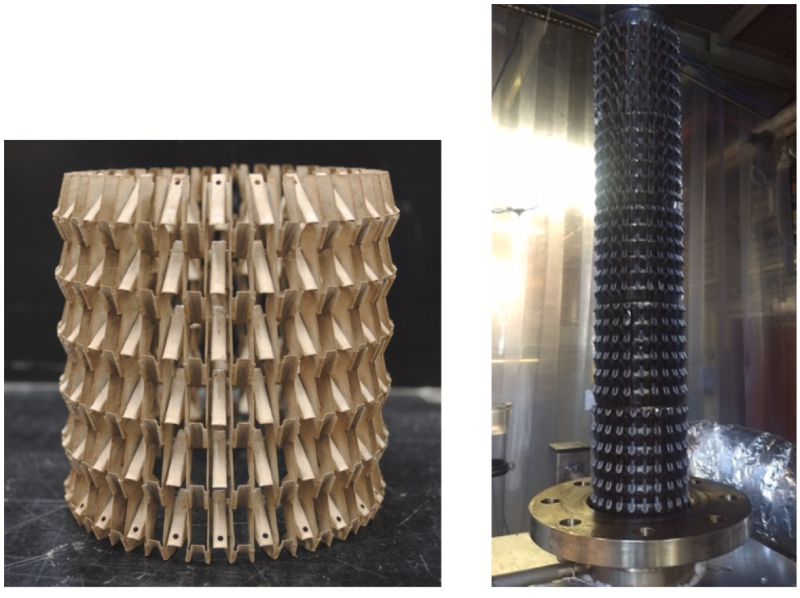
ZoneFlow Reactor Technologies has established the heat transfer and pressure drop properties of ZF Reactors, relative to conventional catalyst pellets, through rigorous experimental testing that has been reported in Chemical Engineering Journal.
Simulations of steam methane reformers with ZF Reactors and pellets, using Aspen process software, reactor and reaction models developed by Prof. Juray De Wilde (Materials and Process Engineering Dept., Université Catholique de Louvain, co-author with Prof. Gilbert Froment of Chemical Reactor Analysis and Design, 3rd Edition (Wiley)), and SMR cost data, were then used to compare the efficiency (including level of carbon emissions) and cost of ZF Reactors and conventional catalyst pellets.
Honeywell’s UOP and ZFRT will cooperate in conducting reactive testing in ZFRT’s large-scale pilot plant at Université Catholique de Louvain in Louvain-la-Neuve, Belgium.
The reactive testing will validate the expected 15% increase in throughput over conventional catalyst pellet systems. Results from the pilot plant testing are expected to be available by mid-2022.
We see the ZoneFlow Reactor Technology as a major breakthrough in steam methane reforming. The much higher throughput possible with the ZoneFlow Reactors will mean significant capital savings for new SMR plants and higher productivity for existing plants. The additional opportunity to reduce the steam requirements to the steam methane reforming process will reduce its energy demands and overall impact on plant CO2 emissions.—Laura Leonard, vice president and general manager, Honeywell UOP Process Technologies
Resources
- Florent Minette, Luis Calamote de Almeida, Sanjiv Ratan, Juray De Wilde (2021) “Pressure drop and heat transfer of ZoneFlowTM structured catalytic reactors and reference pellets for Steam Methane Reforming,” Chemical Engineering Journal, Volume 417, 2021, 128080, ISSN 1385-8947, https://doi.org/ doi: 10.1016/j.cej.2020.128080
Posted on 04 November 2021 in Catalysts, Hydrogen, Hydrogen Production
Honeywell and ZoneFlow Reactor Technologies to Collaborate on Breakthrough Structured Catalyst for Hydrogen Production
Des Plaines, IL and Windsor, CT, Nov. 3, 2021 — Honeywell (NASDAQ: HON) and ZoneFlow Reactor Technologies, LLC today announced a joint agreement to commercialize ZoneFlow™ Reactor Technology. This technology promises to provide a step-change improvement in the efficiency and carbon intensity of steam methane reforming for the production of hydrogen. When coupled with Honeywell H2 Solutions’ carbon capture for hydrogen production, the ZoneFlow technology will make low-carbon hydrogen production more efficient and less expensive. 1,2
The ZoneFlow Reactor, a structured catalyst module (pictured to the right) that replaces conventional catalyst pellets in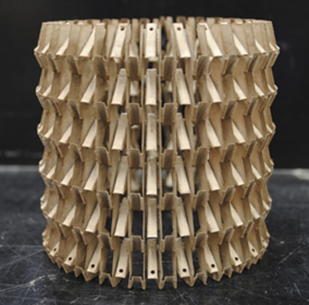 SMR tubes, provides far superior heat transfer and pressure drop performance.2 UOP and ZFRT will cooperate in conducting reactive testing in ZFRT’s large-scale pilot plant at Université Catholique de Louvain in Louvain-la-Neuve, Belgium. The reactive testing will validate the expected 15% increase in throughput over conventional catalyst pellet systems. Results from the pilot plant testing are expected to be available by mid-2022.
“We see the ZoneFlow Reactor Technology as a major breakthrough in steam methane reforming,” said Laura Leonard, vice president and general manager, Honeywell UOP Process Technologies. “The much higher throughput possible with the ZoneFlow Reactors will mean significant capital savings for new SMR plants and higher productivity for existing plants. The additional opportunity to reduce the steam requirements to the steam methane reforming process will reduce its energy demands and overall impact on plant CO2 emissions.”
Note 1 – Based on an internal Techno Economical Analysis using Honeywell UOP developed simulation models, Unisim simulation model, standard PDD tool and optimization. Key variables include cost of CO2 captured, cost of CO2 avoided, stream composition, CO2 delivery requirement (pressure, purity, phase), utility price set, price of H2 and geographic location.
Note 2 – ZoneFlow Reactor Technologies has established the heat transfer and pressure drop properties of ZF Reactors, relative to conventional catalyst pellets, through rigorous experimental testing that has been reported most recently in Chemical Engineering Journal. https://en.x-mol.com/paper/article/1338397261714743296 . Simulations of steam methane reformers with ZF Reactors and pellets, using Aspen© process software, reactor and reaction models developed by Prof. Juray De Wilde (Materials and Process Engineering Dept., Université Catholique de Louvain, co-author with Prof. Gilbert Froment of Chemical Reactor Analysis and Design, 3rd Edition (Wiley)), and SMR cost data, were then used to compare the efficiency (including level of carbon emissions) and cost of ZF Reactors and conventional catalyst pellets.
“This collaboration with Honeywell UOP creates the strongest possible team for the commercial validation and offering of the ZoneFlow Reactor Technology,” said Bruce Boisture, President of ZFRT. “UOP’s broad expertise in catalysts and catalytic processes, coupled with its well-established PSA and carbon capture technologies, make it an ideal technical and commercial participant in this advanced development project. This partnership will provide the technical and financial resources to help demonstrate the breakthrough impact and productivity of the ZoneFlow Reactor Technology.”
Honeywell UOP (www.uop.com) is a leading international supplier and licensor of process technology, catalysts, adsorbents, equipment, and consulting services to the petroleum refining, petrochemical, and gas processing industries. Honeywell UOP is part of Honeywell’s Performance Materials and Technologies strategic business group, which also includes Honeywell Process Solutions (www.honeywellprocess.com), a pioneer in automation control, instrumentation and services for the oil and gas, refining, petrochemical, chemical and other industries.
Honeywell (www.honeywell.com) is a Fortune 100 technology company that delivers industry specific solutions that include aerospace products and services; control technologies for buildings and industry; and performance materials globally. Our technologies help everything from aircraft, buildings, manufacturing plants, supply chains, and workers become more connected to make our world smarter, safer, and more sustainable. For more news and information on Honeywell, please visit www.honeywell.com/newsroom.
ZoneFlow Reactor Technologies, LLC (www.zoneflowtech.com), a privately held company, is a developer of innovative reactor and process technology for the steam methane reforming industry.
# # #
Honeywell media contact:
(973) 216-0684
ZFRT media contact:
860-508-1505
bboisture@zoneflowtech.com